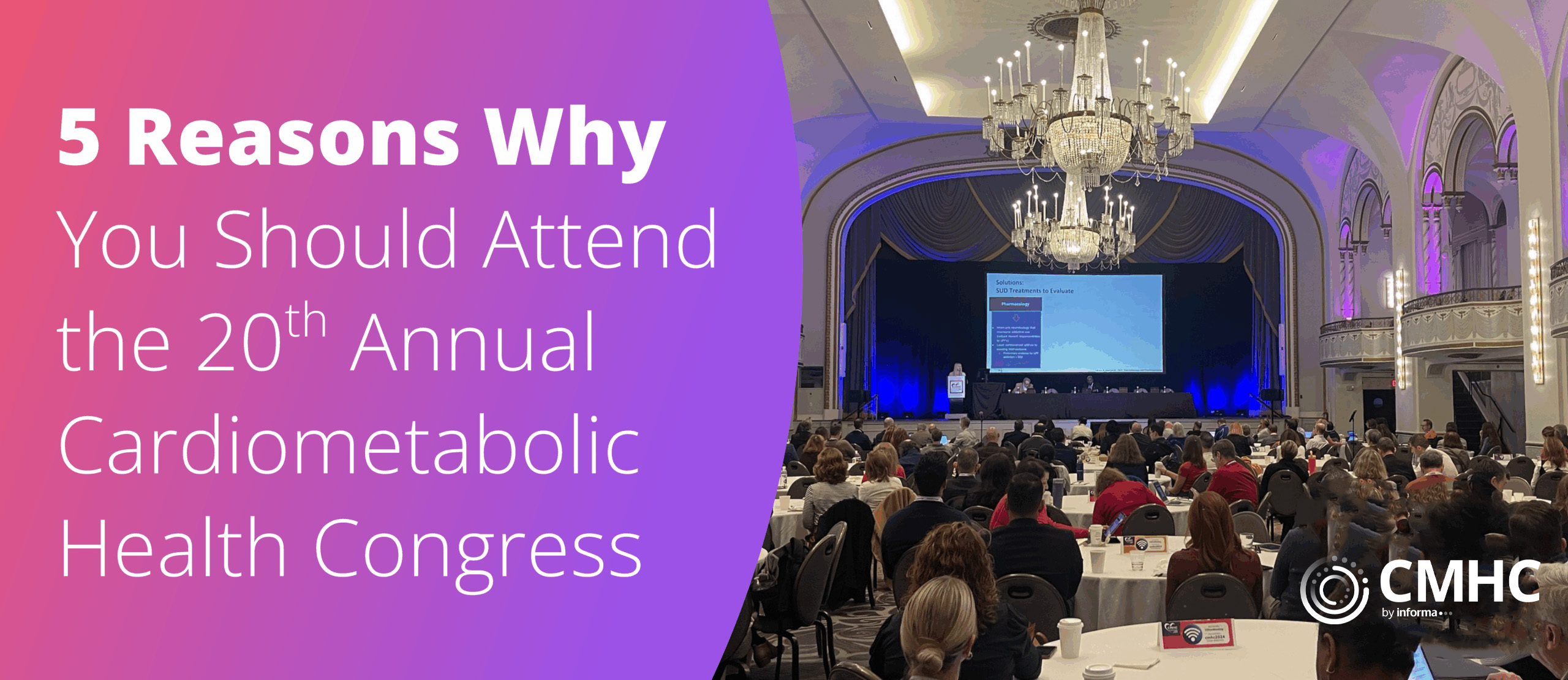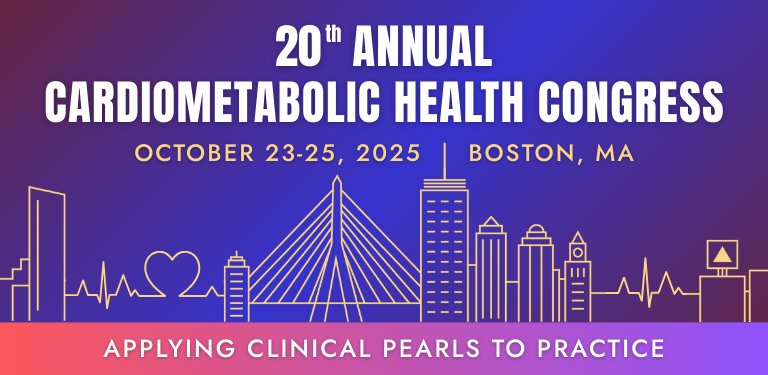

We’re thrilled as the 20th Annual Cardiometabolic Health Congress approaches in just a few short weeks! Friday, October 24th will feature our comprehensive Sessions II. Obesity/Lifestyle and III. Diabetes Management, delivering essential, practice-ready information you can implement immediately with your patients. These sessions will provide you with the latest evidence-based strategies in cardiometabolic care.
We’ve given a few brief highlights for some key presentations in each session and hope you can join us at our milestone event where cutting-edge research meets clinical application.
Session II. Obesity & Lifestyle
This session, chaired by Robert H. Eckel, MD, will thoroughly examine obesity prevention and management through a discussion of comprehensive strategies, including nutritional and lifestyle changes, obesity medications, and their impact on cardiometabolic health.
Featured Presentations:
The Importance of Healthy Lifestyle Behaviors in the Prevention of Cardiovascular Disease
Leonard A. Kaminsky, PhD, FACSM, FAHA, MAACVPR
Poor diet and lifestyle significantly contribute to cardiometabolic disease progression and remain leading causes of global morbidity and mortality. Despite strong clinical guideline support for proper nutrition in cardiometabolic health, many clinicians lack sufficient training to effectively discuss nutrition during patient visits. This presentation will address the consensus recommendations for healthy eating patterns that benefit cardiovascular health, including maintaining healthy body weight, promoting diets rich in vegetables, fruits, whole grains, legumes, nuts, and dairy, while reducing highly processed foods.
Updates in Obesity Pharmacotherapy
Donna H. Ryan, MD
Several recent developments have occurred in obesity management, and clinicians need to stay informed about them. Much of the excitement in the field relates to results published with GLP-1 RAs and dual and triple incretin-based agonists, which experts believe will be key to increasing the use of obesity pharmacotherapy in the near future due to their improved efficacy. Additionally, several other agents are in phase 2 and 3 trials and could become potential tools soon. Furthermore, multiple agents are in advanced development for treating obesity, each with different and complementary mechanisms of action, including dual and triple peptide co-agonists, which may represent the new frontier in obesity treatment. Our expert, Dr. Donna Ryan, will explore the safety, efficacy, clinical implications, and promise of emerging obesity pharmacotherapies.
Primetime CME Symposium MASH Uncovered: Essential Insights for Clinicians on Effective Screening, Risk Stratification, and Disease Management
Chair: Conan Tu, MD MBA
Faculty: Diana Barb, MD; Amreen Dinani, MD, FRCPC ABOM
This comprehensive session will review the latest developments in MASH screening protocols, risk assessment tools, and new treatment options that are changing clinical practice. Our expert faculty will present real-world case study illustrating effective strategies for the early detection and management of this increasingly common condition affecting many patients with metabolic comorbidities. Additionally, we will include patient advocates on our panel, who will share personal experiences of living with MASH, navigating diagnostic obstacles, and managing the complex relationship between liver health and cardiometabolic issues. Their insights will help clinicians better understand patient barriers to care, challenges in treatment adherence, and the psychosocial effects of this often “silent” disease.
Additional Presentations:
- Lancet Commission on Obesity– Robert H. Eckel, MD
- GLP-1 RAs: Do They Benefit Patients with Alzheimer’s Disease, Addictive and Psychiatric Disorders?– Ziyad Al-Aly, MD
- Challenging Obesity & Lifestyle Management Cases with Expert Panel Discussion and Audience Q&A – Cases presented by Layla Abushamat, MD; Rahul Aggarwal, MD joined by all Session II Presenters
Session III. Diabetes Management
Session III, chaired by Anne L. Peters, MD, will explore the individualization of T2D management stemming from the latest evidence-based guidelines and heterogeneity of diabetes typing, as well as the individualization of diabetes therapy according to comorbidities via challenging cases. In addition, this session will explore new and emerging pharmacologic options for diabetic peripheral neuropathy and the prevalence of hypercortisolism in difficult-to-control Type 2 Diabetes.
Featured Presentations:
Bridging the Gap: Enhancing Understanding and Treatment of Diabetic Peripheral Neuropathy (DPN)
Gordon Smith, MD, FAAN
When diabetes treatment is not optimized, patients face a higher risk of developing complications. Diabetic neuropathies are among the most common chronic issues in people with diabetes, affecting nearly 50% of patients. Despite the available treatment options for DPN, patient outcomes remain subpar. Therefore, it is essential for clinicians to recognize DPN early in clinical practice to implement appropriate treatment strategies and prevent serious complications. However, despite its prevalence and serious consequences, many clinicians may not be able to identify the clinical signs of DPN. Additionally, they might lack understanding of the pathogenesis, epidemiology, and biological mechanisms by which DPN influences disease outcomes in patients with diabetes. As a result, underdiagnosis and undertreatment of DPN in clinical settings have been documented. Clinicians would benefit from education on how to identify, diagnose, and treat DPN to improve patient outcomes.
Prevalence of Hypercortisolism in Difficult-to-Control Type 2 Diabetes
Davida F. Kruger, MSN, APN-BC,BC-ADM
The CATALYST study revealed that hypercortisolism is surprisingly common in patients with difficult-to-manage type 2 diabetes, with approximately 24% of poorly controlled diabetes patients showing signs of abnormally high cortisol levels. This percentage increases to 33-36% among patients with heart conditions or those on multiple blood pressure medications. This presentation will highlight hypercortisolism as an important, yet often overlooked factor in treatment-resistant diabetes cases.
Additional Presentations:
- Rethinking Diabetes: Understanding the Heterogeneity of Diabetes Typing – Anne L. Peters, MD
- Challenging Obesity & Lifestyle Management Cases with Expert Panel Discussion and Audience Q&A – Cases presented by Davida F. Kruger, MSN, APN-BC, BC-ADM; Eden M. Miller, DO joined by all Session III Presenters
We are excited to welcome you to this milestone event where cutting-edge research meets clinical application! Join us for these practice-changing sessions that will provide you with the latest evidence-based strategies in cardiometabolic care.
REGISTER: 20th Annual Cardiometabolic Health Congress | Cardiometabolic Health Congress
AGENDA: Full Schedule